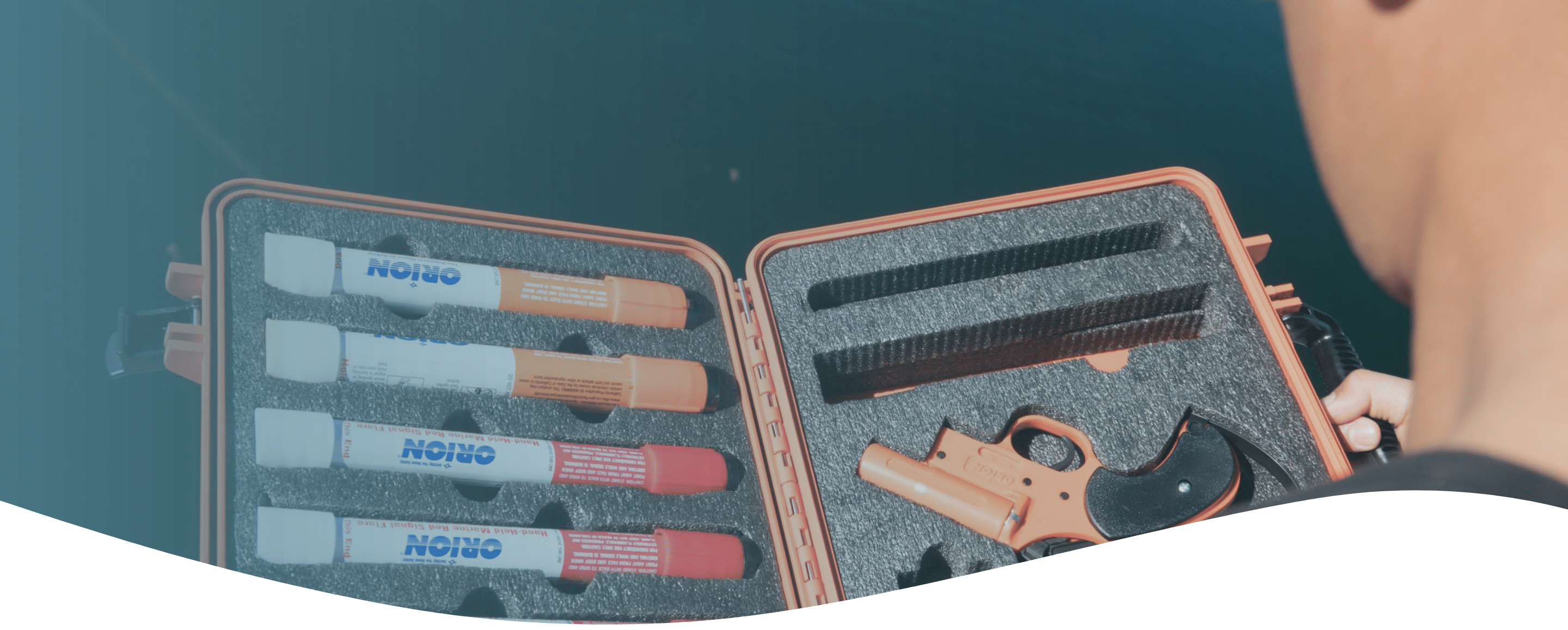
Each time, before you leave shore, familiarize yourself with your emergency signals. Time is important in an emergency, and you should not have to waste time in reading instructions. In addition, make sure that all crew and passengers are also familiar with the location and method of operating the signals. Include older children in the instruction. If the skipper is incapacitated, it is essential that others on board are able to call for help and activate the emergency flares.
What Should You Do Before Using Distress Flares
The most effective and reliable way to call for help in an emergency is to issue a distress signal (Mayday) is with a marine VHF radio. Keep your radio tuned to channel 16 and always know your boat location and be prepared to describe the name and position of your vessel, the nature of your emergency, and the type of assistance you need.
In an emergency:
- Ensure each person on board is wearing a life jacket or PFD.
- Have gloves available to handle hot flares.
- Fire aerial flares at an angle upwind.
- Hold lighted flares over the downwind side of the boat.
- Do not point flares at anyone and hold away from your body.
- Don’t panic.
When to Call a Distress
It is an offence to call a radio distress signal (Mayday) unless your vessel or a passenger is in “grave or imminent danger”. Examples would be: your vessel is in danger of sinking, your vessel is not under control and is being blown onto rocks, or a passenger has had a serious or life-threatening injury.
Similarly, marine flares should not be discharged unless the situation is equally dangerous. Your VHF Radio is the first line of defense when informing Canadian Coast Guard, as well as any other vessels in your vicinity, of your distress. Communication between your vessel and the Coast Guard can then be monitored by nearby vessels, and appropriate action to help taken by them, if necessary. In addition, if the Coast Guard cannot pick up your VHF radio transmission, or you cannot pick up their response, a nearby vessel may be able to act as a relay station to establish and maintain communication. VHF is therefore the method of communication preferred by the Coast Guard.
The use of a cell phone will let you communicate directly with the Coast Guard (*16). However, the use of a cell phone eliminates contact with all other, “Vessels of Opportunity4” in your vicinity that may be able to render assistance. USE BOTH VHF AND A CELL PHONE IF YOU HAVE THEM AVAILABLE! A vessel is deemed a “vessel of opportunity” when it is in close proximity to an incident on board another vessel, when authoritative assistance is not available. Under marine law vessels must give assistance to a vessel in distress. The exception is that, if in doing so, a skipper would compromise their vessel.
In either case, using VHF or using a cell phone, once you have contacted the Coast Guard have your position ready to give to them. They will then determine the probable length of time before rescue can arrive. You should be ready to deploy your distress signals in an orderly planned method when the rescuing craft, airplane, or helicopter is close at hand.
When to Signal With Flares
Aerial flares should be fired only after sighting or hearing a potential rescuer. Experts recommend that, once an aircraft or rescuing vessel has been sighted, one flare should be fired, followed by a second one within 10 seconds, to let search teams confirm the sighting and the direction of the signal. Remember that search and rescue missions often establish grid search patterns. This means that, in the case of aircraft, you may see the same aircraft two or three times coming at you from different directions. Do not waste aerial flares if the aircraft has initially passed by you. Carrying extra flares will improve your chances of being sighted. This is a good reason to carry expired flares as a backup, in addition to the mandatory ones.
When to Use Aerial Flares
To attract the attention of the rescuer the Canadian Coast Guard recommends that you fire two aerial flares, one within 10 seconds of the other, so rescuers can confirm the sighting and the direction of the signal. Parachute flares do not need to be fired in pairs since a single flare has an adequate burn time (40 seconds) to confirm a sighting and position. Aerial flares can be seen for a considerable distance; up to about 50 km (27 nautical miles) in good visibility. Aerial flares should only be fired in open areas to avoid the possibility of an accident.
When to Use Hand-held Flares
Hand-held signal flares are intended for closer ranges than the aerial flares. They act as homing signals to pinpoint your position to potential rescuers. The surface sighting range on water is approximately five to eight km (2.5–4.5 nautical miles), depending on vessel elevation and height of eye. If a rescue vessel is eight km (4.5 nautical miles) away and is running at 20 knots, it will take about 15 minutes to reach you. Therefore, you should have at least 12 minutes of total burn time for your signals on board to maintain a strong homing signal until help arrives.
Suggested Distress Signals to Have On Board
It is mandatory for certain sizes and types of vessels to carry distress signals on board. However, regardless of the law, it is essential to have enough distress signals of the correct type to increase your chances of detection
in an emergency.
Remember that the unexpected often happens. Be prepared to cope with night conditions, restricted visibility, etc. This may mean purchasing additional distress signals as well as those mandatory to carry on your boat.
The following is suggested when considering what types of distress signals to carry on board your boat:
| Type A | Type B | Type C | Type D | |
| Day Cruising | • | • | • | • |
| Night Cruising | • | • | • |
The quantities that you carry will depend on the size of your vessel and the type of cruising that you do. Review the required equipment list in the Canadian Safe Boating Guide.
Where Should Distress Flares be Stored
Flares should always be kept dry and cool. Store them in a plastic container, not a flimsy plastic bag. Apply tape around the seal of the container and keep it away from sources of heat or flame. Flares should be stored in a floatable container, and their condition should be checked before each trip.
Flares must be easily accessible during an emergency. Allocate a special location for your distress signals, perhaps in your “grab and go” bag along with your other survival gear.
Do not store your flares in the bottom of a drawer or locker.
Using Flares
Shoot aerial signals into the wind at an angle of 45° to 90° depending on the velocity of wind. Use lower angles in higher wind strengths. Hold hand-held distress signals over the side of the vessel and discharge them downwind. You should be aware of the possible hazards posed by flares. Keep flares away from children; they are not toys. Never point them at any person or structure. Keep your hands away from the burning end of the signal. Look away while firing or burning a signal. Be aware that there may be a slight delay in the activation of the signal, so continue to hold it in the appropriate position until you are sure that it is not going to function. If it is faulty, drop it in the water. Be aware of the recoil and loudness of types A and B, and that types C and D may drop particles. Be careful to hold them over the side of the vessel.
It is wise to conserve your flares until you are reasonably sure that a rescuer has sighted your boat. Wait until you see or hear a vessel or aircraft before using your “one time” signals.
Always stay with your vessel as long as it is safe to do so. Your chances of being rescued are greatly improved, as your boat will be much more easily spotted than a person in the water.
Canadian Coast Guard approved marine signals improve your chances of rescue, but anything that works is good. Use common sense!
- shout
- wave your arms
- flash your running lights
- wave a piece of cloth
- use your windshield as a mirror
- use your flashlight
- use anything that is available to attract attention
- Above all, do not panic
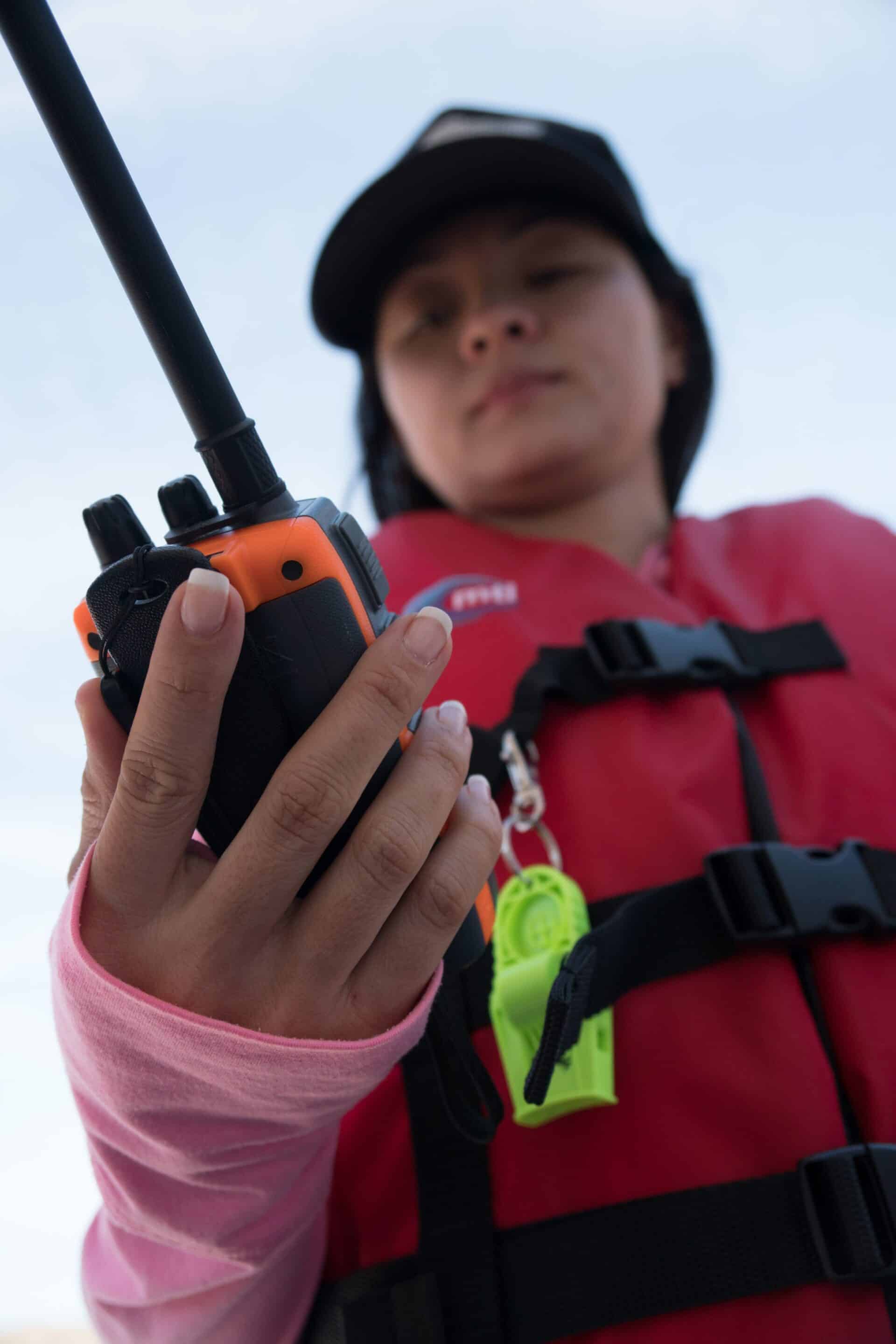
VHF MARINE RADIO COURSE
Get VHF Radio Certified
If you have a VHF radio on board, certification is legally required. It’s the Law. Not having an Restricted Operator Certificate Maritime (ROC-M) can result in significant fines.
With our in-depth course, you’ll gain the skills to:
- communicate clearly,
- call for help instantly,
- and stay connected on the water.
Whether you’re navigating busy marinas or handling an emergency, knowing the right radio procedures makes all the difference.