
OWNERSHIP
From Muskoka and Georgian Bay to Lake Ontario, and the Trent-Severn Waterway and countless other lakes and rivers, Ontario offers wonderful boating destinations to explore. Summer is a time to unwind, and for many, that includes lakeside happy hour. If you’re thinking about consuming alcohol while on a boat, it’s important to know the rules. And of course, if you are operating a boat, the safest choice is to have to have no alcohol or drugs in your system.
Can You Drink on a Boat in Ontario?
The simple answer is no. Neither the driver nor passengers, may drink on a recreational vessel when it is underway (in motion). However, exceptions apply to larger boats that have proper living facilities and are not in motion that we’ll explain in this article.
It is safest to have no alcohol in your system if you are operating a boat. According to the Life Saving Society, drowning is the most common boating injury associated with alcohol, accounting for about 30 per cent of boating deaths.
Rules for Legally Consuming Alcohol on a Private Boat
In most cases, for anyone to drink alcohol the vessel must be:
- at anchor or
- tied up to the dock and
- equipped like a private residence.
There must be:
- fixed toilet facilities (no porta potties),
- permanent cooking facilities and
- permanent sleeping facilities on board.
When you hoist anchor or leave the dock operators must not be under the influence of alcohol. Consumption of alcoholic beverages only serves to intensify, fatigue, sun, wind and motion to dull your senses and abilities to react. Lack of hand eye coordination and impaired judgement is often the result.
Ontario Blood Alcohol Concentration Thresholds:
A boat is a vessel in the same way a car is a vehicle under the Highway Traffic Acts. Therefore, Ontario impaired driving laws also apply to those operating boats.
If police determine that you have drugs or alcohol in your system and/or that you are impaired by any substance, you can face severe consequences and potential criminal charges. Penalties can by determined by police based on the Blood Alcohol Concentration (BAC) and breathalzyer tests. Refusing to provide a breath sample is a criminal offence under the Criminal Code of Canada.
Blood Alcohol Concentration (BAC) Limits and Penalties for Ontario:
- Criminal Limit (0.08+): A BAC of 0.08% or higher is a criminal offense.
- Warn Range (0.05–0.079): If your BAC is between 0.05 and 0.079, you are in the “warn range” and face provincial administrative penalties.
- Zero Tolerance (0.00): Under 22, and commercial drivers must have a BAC of 0.00.
Visit Ontario.ca for the latest information.
Provinces and territories have their own rules on legal alcohol limits, when you can drink and how alcohol can be carried on board. Contact your local law enforcement authorities for more information. If you are convicted in Canada of driving a vehicle under the influence, you lose your license.
Learn more about Calculating BACs from Madd Canada.
Ontario-Specific Penalties
Drinking, on the water, except as noted above, is illegal and punishable under the Criminal Code. For the first offence fines are no less than $600, prohibition from operating a vessel could be for up to three years as well as possible imprisonment.
Provinces have their own rules but in Ontario, for example, if caught drinking while operating a vessel you could immediately lose your automobile driving privileges for 12 hours. If you blow over the legal limit there is an automatic 90-day driver’s license suspension and if convicted that could be extended to a year and that is just for the first offence.
What to Expect During a Police Inspection
During the summer, it’s common to encounter marine enforcement while boating. Police may stop or approach your vessel to conduct safety equipment inspections. If they need to speak with you, they will typically wave you down or activate their blue lights.
If this happens, reduce speed, move to a safe area away from heavy traffic if possible, and shut off your engine when directed. Officers may pull alongside your boat and secure themselves while asking to see your required safety equipment, proof of operator competency or Pleasure Craft Operator Card (PCOC) and your Pleasure Craft Licence (PCL) documentation.
Marine officers are also on the water to monitor for reckless or impaired boating, enforce regulations, and assist with Search and Rescue calls when needed.
Tips for a Smooth Inspection:
- Have your Pleasure Craft Operator Card and ID available
- Ensure your required safety equipment is onboard and easy to locate
- Check your navigation lights, flashlight and fire extinguisher before leaving the dock
- Ensure everyone onboard is wearing lifejackets of the correct size
Additional FAQs:
Is Drinking Illegal in a Canoe, Kayak, Paddle board (SUP), or Floatie?
In Ontario, if caught drinking while operating a vessel (motorized watercraft, pontoon boat, jet ski or non-motorized boats such as canoes, kayaks, paddle board, and inflatable rafts) you could immediately lose your automobile driving privileges for 12 hours.
Can You Legally Transport Liquor or Alcohol by Boat?
In Ontario, alcohol can only be transported by boat from residence to residence and must be in unopened bottles and in a closed container or locker. It is the responsibility of the vessel operator to be able to prove this to an enforcement officer.
Can Passengers Drink on a Private Boat?
In Ontario, passengers can consume alcohol, but only if the boat is:
- anchored or
- docked, and has:
- permanent cooking facilities and
- permanent sleeping facilities on board
Provinces and territories may have their own rules. Contact your local law enforcement authorities for more information.
Exceptions apply for Commercial Cruises and Tour Operators. They are are permitted serve alcohol to passengers from their licensed bars that can be consumed when the boat is underway.
Cannabis and Boating:
Under subsection 253(1) of the Criminal Code, you may not operate, assist in the operation of, or have the care or control of a vessel while impaired. This applies whether or not the vessel is moving. It also applies whether you are using alcohol or drugs, or both.
It is illegal to drive and operate a vessel while having:
- a THC level between 2 and 5 nanograms (ng)
- a level above 5 ng
- a blood alcohol concentration of 50 mg per 100 mL of blood, in addition to a THC level of more than 2.5 ng
By: John Gullick and Vanessa Schmidt
John Gullick, currently CanBoat’s Manager of Government and Special Programs and has been an active recreational marine specialist and writer for over 50 years.
BOATERS HELPING BOATERS
Need More Information?

Get Your Boating Licence
Regardless of boat length or engine horsepower, all motorized boat operators in Canada are required by law to have a PCOC.
Free Safety Gear Checks
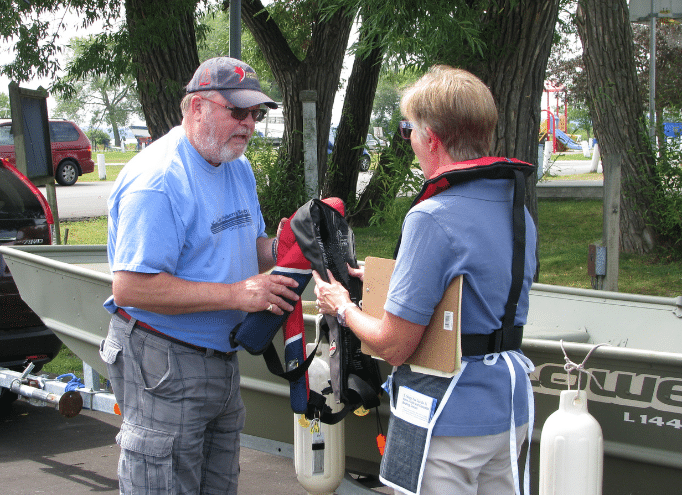
CanBoat volunteers will check your boat for free… and if you have everything you need, you’ll get a Safety Inspection Sticker.

Safe Boating Guide
Safety Tips and Required Equipment lists. Download a PDF of Canada’s Safe Boating Guide.
CanBoat / NautiSavoir offers the most comprehensive and recognized courses, built by boaters, for boaters to get you and your crew ready for every adventure and any situation.
Members are eligible for 20% discount on courses.